
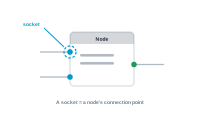
A socket is a connection point on a node – the spot where a wire attaches. Sockets are how nodes pass data to one another.
If a node is a little machine, its sockets are its plugs. An input socket receives data coming into the node; an output socket sends the node’s result onward. You draw a connection from one node’s output socket to the next node’s input socket, and data can travel along it.
Sockets are what turn a pile of separate nodes into a working flow. The pattern is always the same – output to input, output to input – so once you’ve connected a couple of nodes, you understand how to connect them all. They also keep things honest: a node can only get data through an input socket, so you can always trace exactly where a value came from by following the wire back.
Beyond direction (in or out), each socket has a type – the kind of thing that flows through it, such as data, a style, an action, or a hyperlink. You connect sockets of the same type. Condition nodes also add success/fail sockets for branching. The next article breaks the types down.
Read the different socket types: In, Out, Success, Fail