
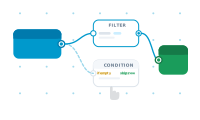
Here’s the easiest way to picture how data moves in the editor: think of a spider’s web. The central node is the spider, sitting in the middle, and every thread of your graph runs toward it. When it’s time to produce a value, the spider pulls the threads – and the data comes to it.
You build your nodes out along the threads – reading fields, formatting text, making decisions. None of it runs on its own. It runs because the spider at the center pulls it in when a value is needed. Data is gathered toward the central node, not pushed out from the edges.
That’s why this is called a pull model: the center asks, and the answer travels in along the threads.
You read a graph left to right, like a sentence – but remember that everything ultimately flows into the spider at the center. Find the central node, and you’ve found where it all ends up.
Meet the spider itself: What Is a Central Node?